Quotable "The nationalist not only does not disapprove of atrocities committed by his own side, he has a remarkable capacity for not even hearing about them." -- George Orwell Read an interview with the Abu Ghraib whistleblower.
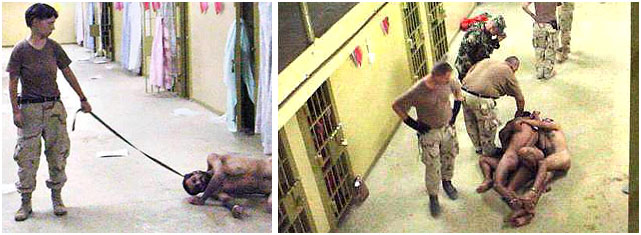
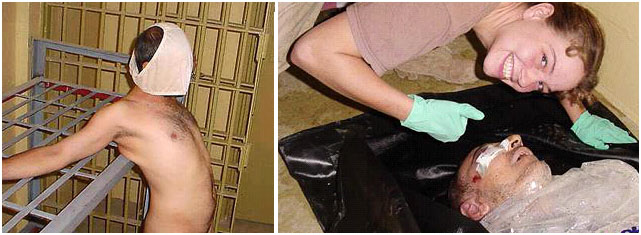
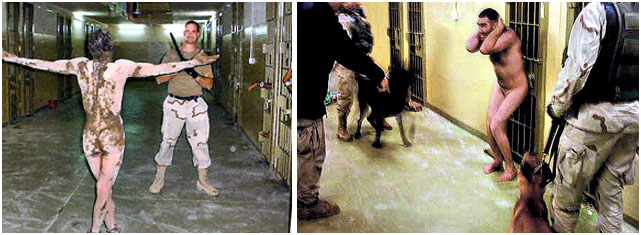
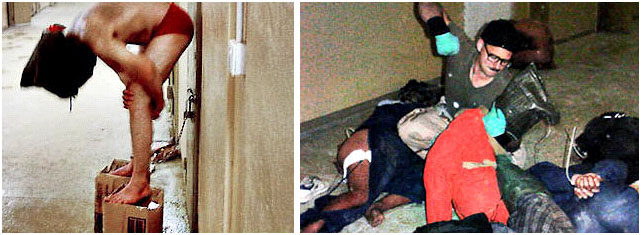
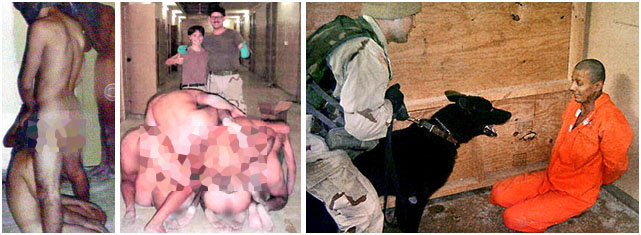
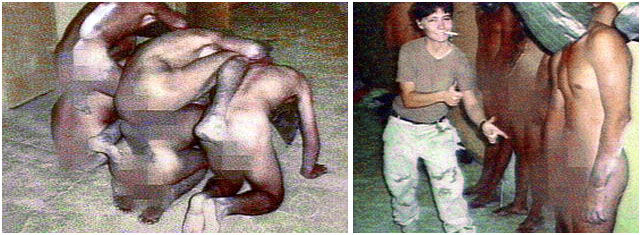
Meet the new boss (Obama), same as the old boss (Bush) Robert Gates granted new authority to block photos showing sexual abuse of women and under-age boy by US military while in custody. -- SHAME! Secretary of Defense Robert Gates has blocked the release of photographs depicting US soldiers abusing detainees in Iraq and Afghanistan, invoking new powers just granted to him by Congress that allows him to circumvent the Freedom of Information Act (FOIA) and keep the images under wraps on national security grounds. In a brief filed with the US Supreme Court late Friday, Department of Defense General Counsel Jeh Johnson, and Solicitor General Elena Kagan, said Gates "personally exercised his certification authority" on Friday to withhold the photos and "determined that public disclosure of these photographs would endanger citizens of the United States, members of the United States Armed Forces, or employees of the United States Government deployed outside the United States." "Based on that determination, the Secretary has concluded that the photographs are 'protected documents'" and are "exempt from mandatory disclosure under FOIA," the government's brief states. In his certification included with the filing, Gates said his decision to withhold as many as 2,000 photos was based "upon the recommendations of the Chairman of the Joint Chiefs of Staff [Michael Mullen], the Commander of U.S. Central Command [David Petraeus], and the Commander of Multi-National Forces-Iraq [Ray Odierno]..." As first reported by truthout, the photographs at issue include one in which a female solider is pointing a broom at a detainee "as if [she were] sticking the end of a broomstick into [his] rectum." Other photos are said to show US soldiers pointing guns at the heads of hooded and bound detainees in prisons in Iraq and Afghanistan. The Army's Criminal Investigation Division investigated the matter and "three of the six investigations led to criminal charges and in two of those cases, the accused were found guilty and punished," according to papers Kagan previously filed with the Supreme Court. The ACLU filed a FOIA request in 2003 to gain access to photographs and videos related to the treatment of "war on terror" prisoners in US custody and sued the government a year later to enforce the FOIA filing. The US District Court for the Southern District of New York ordered the release of the photos in a June 2005 ruling that was affirmed by the US Court of Appeals for the Second Circuit in September 2008. The Bush administration challenged the Second Circuit's ruling, and in March the court denied that petition. In its earlier ruling, the appeals court also shot down the Bush administration's attempt to radically expand FOIA exemptions for withholding the photos, stating that the Bush administration had attempted to use the FOIA exemptions as "an all-purpose damper on global controversy." The Obama administration indicated it would abide by the appeals court order and release at least 44 of the photographs in question, but, in May, after he was pilloried by Republicans, President Obama backtracked, saying he had conferred with high-ranking military officials who advised him that releasing the images would stoke anti-American sentiment and would endanger the lives of US troops in Afghanistan and Iraq. As Truthout previously reported, the Obama administration petitioned the US Supreme Court to hear the case last summer. The petition raised similar arguments related to FOIA exemptions in this case as those made by the Bush administration and later rejected by the Second Circuit. Last month, in an effort aimed at quashing the Second Circuit's decision, Congress passed a Homeland Security appropriations bill, which President Obama signed into law, that included a provision to amend FOIA and and give Gates the authority to withhold "protected documents" that, if released, would endanger the lives of US soldiers or government employees deployed outside of the country. The amendment was originally sponsored by Sens. Joe Lieberman, (I-Connecticut), and Lindsey Graham, (R-South Carolina). Obama sent a letter to the lawmakers last summer stating that he would work closely with Congress to help pass the measure to keep the abuse photographs sealed, according to a footnote in the administration's Supreme Court petition. Rep. Louise Slaughter, (D-New York), who opposed the FOIA amendment, said in a floor statement in October as Congress was debating the provision, that the language, stripped from an earlier version of the bill, was quietly reinserted "apparently under direct orders from the [Obama] administration." According to the bill, the phrase "protected documents" refers to photographs taken between September 11, 2001 and January 22, 2009, and involves "the treatment of individuals engaged, captured or detained" in the so-called "war on terror." Photographs that Gates determines would endanger troops and government employees could be withheld for three years. The ACLU said Gates' certification "is categorical with respect to all of the photos and fails to provide the individualized assessment that the amendment's language requires and also fails to provide any basis for the claim that disclosure of the photos would harm national security." The group intends to file a response to the administration's brief next week. In an oped column published in the Los Angeles Times last month, Jameel Jaffer, director of the ACLU's National Security Project, said although the powers Congress granted Gates is meant to cover the abuse photos, it "could also cover, for example, video footage of aerial attacks that resulted in civilian casualties or photos showing the conditions of confinement at the Bagram detention center in Afghanistan." "The legislation establishes a regime of censorship that would extend to many images of the military's activities abroad." Jaffer wrote. Obama's decision to sign legislation into law that allows his administration to circumvent FOIA marks an about-face on the open-government policies that he proclaimed during his first days in office. On January 21, Obama signed an executive order instructing all federal agencies and departments to "adopt a presumption in favor" of Freedom of Information Act requests, and promised to make the federal government more transparent. "The government should not keep information confidential merely because public officials might be embarrassed by disclosure, because errors and failures might be revealed, or because of speculative or abstract fears," Obama's order said. "In responding to requests under the FOIA, executive branch agencies should act promptly and in a spirit of cooperation, recognizing that such agencies are servants of the public." Instead of withdrawing its petition now that legislation has been passed, the Obama administration on Friday asked the high court to vacate the Second Circuit's ruling, and then "remand to allow the lower courts to address the effect of the new legislation on the litigation." "Given Congress's enactment of intervening legislation resolving the present dispute by providing for withholding of the records at issue, the Court now has no occasion to address the proper construction of [FOIA] Exemption 7(F) as set forth in the government's petition," the government's filing states. "The appropriate disposition, after these events, is for this Court to [pull the case up from the Second Circuit and take jurisdiction of the case and the issue], vacate the judgment of the court of appeals, and remand for further proceedings... in light of the intervening legislation" passed by Congress. In its earlier Supreme Court petition, the Obama administration argued that FOIA Exemption 7(F) allows for the withholding of information if it threatens the lives of individuals. The Second Circuit, however, disagreed. The court ruled that FOIA "mandates the public disclosure of such photographs -- regardless of the risk to American lives -- because FOIA Exemption 7(F) requires the government to 'identify at least one individual with reasonable specificity' and show that disclosure 'could reasonably be expected to endanger that individual.'" The government argued that the Second Circuit misinterpreted the law when it ruled that the government had to identify specific individuals who would be harmed by the disclosure of the photographs.MO The Obama administration maintained that the Second Circuit's interpretation of Exemption 7(F), "is inconsistent with the text of Exemption 7(F), which broadly encompasses danger to 'any individual,' with no suggestion of the court's extra-textual requirement of victim specificity. The history of drafting that exemption "underscores that conclusion. Congress did not mean for public disclosure of agency records to trump the life and physical safety of individuals - particularly in a case such as this, in which the government has already made public the underlying investigative reports revealing all relevant allegations of wrongdoing and the associated investigative conclusions." "The President and the United States military fully recognize that certain photographs at issue depict reprehensible conduct by American personnel and warranted disciplinary action," the government's petition states. "There are neither justifications nor excuses for such conduct by members of the military. But the fact remains that public disclosure of the photographs could reasonably be expected to endanger the lives and physical safety of individuals engaged in the Nation's military operations in Iraq and Afghanistan. The photographs therefore are exempt from mandatory disclosure under FOIA. Review by this Court is warranted to give effect to Exemption 7(F) and the protection it affords to the personnel whose lives and physical safety would be placed at risk by disclosure." Alex Abdo, a legal fellow with the ACLU's National Security Project, said the Obama administration's argument for continuing to suppress the photos "sets a dangerous precedent -- that the government can conceal evidence of its own misconduct precisely because the evidence powerfully documents gross abuses of power and of detainees. "This principal is fundamentally anti-democratic. The American public has a right to see the evidence of crimes committed in their name." May 29, 2009: Pictures banned by Obama show an American soldier apparently raping a female prisoner while another is said to show a male translator raping a male detainee! Further photographs are said to depict sexual assaults on prisoners with objects including a truncheon, wire and a phosphorescent tube. Detail of the content emerged from Major General Antonio Taguba, the former army officer who conducted an inquiry into the Abu Ghraib jail in Iraq. Allegations of rape and abuse were included in his 2004 report but the fact there were photographs was never revealed. He has now confirmed their existence in an interview with the Daily Telegraph. The graphic nature of some of the images may explain the US President's attempts to block the release of an estimated 2,000 photographs from prisons in Iraq and Afghanistan despite an earlier promise to allow them to be published. Maj Gen Taguba, who retired in January 2007, said he supported the President's decision, adding: "These pictures show torture, abuse, rape and every indecency. "I am not sure what purpose their release would serve other than a legal one [emphasis mine, honestly, you can't make this up - editor] and the consequence would be to imperil our troops, the only protectors of our foreign policy, when we most need them, and British troops who are trying to build security in Afghanistan. "The mere description of these pictures is horrendous enough, take my word for it." In April, Mr Obama's administration said the photographs would be released and it would be "pointless to appeal" against a court judgment in favour of the American Civil Liberties Union (ACLU). But after lobbying from senior military figures, Mr Obama changed his mind saying they could put the safety of troops at risk. Earlier this month, he said: "The most direct consequence of releasing them, I believe, would be to inflame anti-American public opinion and to put our troops in greater danger." It was thought the images were similar to those leaked five years ago, which showed naked and bloody prisoners being intimidated by dogs, dragged around on a leash, piled into a human pyramid and hooded and attached to wires. Mr Obama seemed to reinforce that view by adding: "I want to emphasise that these photos that were requested in this case are not particularly sensational, especially when compared to the painful images that we remember from Abu Ghraib." The latest photographs relate to 400 cases of alleged abuse between 2001 and 2005 in Abu Ghraib and six other prisons. Mr Obama said the individuals involved had been ìidentified, and appropriate actions" taken. Maj Gen Taguba's internal inquiry into the abuse at Abu Ghraib, included sworn statements by 13 detainees, which, he said in the report, he found "credible based on the clarity of their statements and supporting evidence provided by other witnesses." Among the graphic statements, which were later released under US freedom of information laws, is that of Kasim Mehaddi Hilas in which he says: "I saw [name of a translator] ******* a kid, his age would be about 15 to 18 years. The kid was hurting very bad and they covered all the doors with sheets. Then when I heard screaming I climbed the door because on top it wasnít covered and I saw [name] who was wearing the military uniform, putting his **** in the little kid's ***.... and the female soldier was taking pictures." The translator was an American Egyptian who is now the subject of a civil court case in the US. Three detainees, including the alleged victim, refer to the use of a phosphorescent tube in the sexual abuse and another to the use of wire, while the victim also refers to part of a policemanís "stick" all of which were apparently photographed. For anyone who missed it -- and many chose to look away -- these are the pictures that the rest of the civilized world viewed on their news programs, newspapers and magazines. They are examples of the kind of treatment that the American military gave to Iraqi people who were "suspected" of being "the enemy." Almost all of the prisoners who survived this treatment (some, as you can see, did not survive) were subsequently released because of lack of any evidence. This is an example of why America is hated in much of the world today. So much has changed in just the past six years... one can only ask "why?" 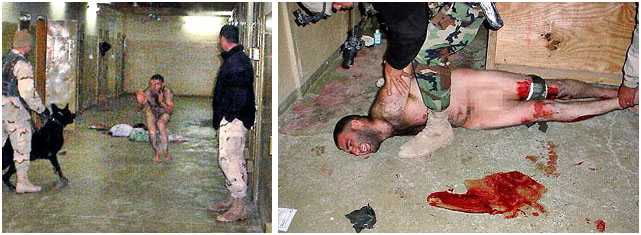
Really... what can you say? But remember... not to speak is to consent. Photos provided by www.antiwar.com Obama Makes a Terrible Mistake by Not Releasing Torture Photos
The Prosecution of George W. Bush for Murder is the best book I have read in years. Sadly it will never happen because the people that should do it supported Bush and his policies are still in office and share in his guilt. They would have prosecute themselves as well, and that ain't gonna happen.
This is an unbelievable moment. Dick Cheney's PR offensive over the last month actually worked. Barack Obama just crumbled and will follow Cheney's command to not release the new set of detainee abuse pictures.
By the way, if you hadn't figured it out by now, that's why you saw every Cheney in the world on television arguing that torture works and that releasing more information would gravely harm the troops. They weren't worried about what was already released; they were worried about what was going to get released. They were trying to pre-empt the most damaging thing of all - the pictures that show the torture.
Just talking about torture doesn't really do it for the American people. But when they see pictures, they get it. That's why Bush had to apologize profusely and throw a few low-level soldiers under the bus when the Abu Ghraib pictures came out. You think there would have been anywhere near that level of controversy or accountability (such that it was) without the pictures?
How many Americans have heard of Bagram Air Base and how we tortured people to death there? A scant few. How many would have heard of it if there were pictures of detainees shackled from the ceiling or a Palestinian hanging or bleeding to death? Pictures are worth a billion words.
You know why? Television! If something isn't on television, it didn't happen. And television producers are obsessed with visuals (makes some sense since it's a visual medium, but their obsession winds up dumbing down the news if there aren't any pictures or video to go along with an important story).
Television has a multiplier effect. The New York Times story on how we beat a man named Dilawar to death at Bagram just sits there and whoever reads it, reads it. And then, it's done. On television stories spread and multiply and get spread to other channels and other mediums. Television doesn't just report the news; it decides what the news is.
So, that is what this whole fight has been about - the pictures. And now Obama adopted Cheney's position that it endangers national security to release the pictures and he will be saddled for the rest of time with the obligation to fight Cheney's battle for him. And anytime any reasonable person makes a case that as a free and open democracy we should know what our government did, the right-wing will counter with, "Even Obama thinks it endangers national security!"
The reason why this is such a maddening argument is that it is so f'in obvious that the real problem isn't releasing the pictures; it's what we did in the pictures. The argument that Obama so stupidly accepted just now shifts the blame from the people who committed the abuse to the people who want to uncover it and put an end to it.
If you released the pictures and show how the "enhanced interrogation" memos directly led to these abuses, there would be no more torture debate. Everyone could see with their own eyes the horrific results of torture. Now instead, Obama has not just protected the torturers, but empowered them. They now get to claim they tried to protect America and that anyone who tries to show their misdeeds endangers America.
The news reports will tell you that Obama listened to his generals on this. Yes, who put Gen. David Petraeus and Gen. Ray Odierno in their current positions? Oh yes, George W. Bush and Dick Cheney. Very fair and balanced advice you would get from them. This isn't about protecting the troops; it's about protecting their own behinds. They might have been in the chain of command that allowed this abuse to happen. Expecting unbiased advice from them is ridiculous.
Now, it looks to the rest of the world that we are trying to hide something, that we have not turned over a new leaf, that it is the same old lies and duplicity - and that Obama is on it. This was colossally stupid.
And to add insult to injury, we have to reconcile ourselves to the fact that Dick Cheney still runs DC no matter how unpopular and despicable he is. He still has the Democrats eating out of his hand. Pathetic. Absolutely pathetic.
There should be an overwhelming Democratic and media revolt over this decision. The Democrats cannot be like the Republicans and bow their heads at all of the president's decisions. They should fight him tooth and nail on this. Don't hold your breath. Other than Feingold and a few others, they will all immediately lay down.
But I come back to a question that keeps popping back up - are there any real journalists in this country? Has everyone become so obsessed with access and so cowed by possible governmental reaction that they don't actually do their job anymore? They seem so damn frightened by what the big, bad government might say about them.
If there's a real journalist in this country, they will get their hands on those pictures and release them to the world. We did what is in those pictures. The longer we cover it up, the more culpable we all become. Not showing the pictures doesn't make the reality of what happened go away. It only aids and abets the torturers who did the crimes and stained this country's name. They should all be thrown into the sunlight. This is what the press is supposed to do.
Now, are so-called journalists going to act or are they going to just sit there and take it again? We're going to find out if we have attack dogs in the press that uncover the truth as it actually is or if we just have a bunch of lap dogs that can't wait for their master to give them the crumbs off his table. This is a litmus test. Is this an free and open country, or isn't it?
But wait!!!! There's more... read the following article about even more cover-ups by Obama. Where is the transparent government? This is the same old same old...[editor]
The Obama administration has threatened to restrict intelligence sharing arrangements with Britain if a court publishes details of the treatment of Binyam Mohamed, the former Guantanamo Bay inmate.
Trial Illuminates Dark Tactics of Interrogation
Friday 20 January 2006
Ft. Carson, Colo. - It was dubbed the "sleeping bag technique."
Interrogators at a makeshift prison in western Iraq, desperate to break suspected insurgents, would stuff them face-first into a sleeping bag with a small hole cut in the bottom for air.
Chief Warrant Officer Lewis E. Welshofer Jr. used it on an Iraqi general as a last-ditch grab for information as Welshofer's unit was in the midst of an offensive against insurgents and desperate for intelligence.
The technique was not in the Army Field Manual, but Welshofer testified Thursday that he believed it was permitted after top commanders told interrogators "the gloves were coming off."
But Welshofer got no information.
Military prosecutors allege that Maj. Gen. Abed Hamed Mowhoush, 57, suffocated in the sleeping bag as Welshofer sat on him. Welshofer's murder trial, which began this week at the home base of the 3rd Armored Cavalry Regiment to which he was assigned in Iraq, opens a window into the murky world of military interrogations.
Issues raised by the prosecutors and the defense about how to calibrate interrogations during the war against terrorism echo those made during the Abu Ghraib prison scandal and the recent debate in Washington over banning torture.
Welshofer described spending months in Iraq without any clear directives about how to manage interrogations. When rules came down, he said, they were vague and he soon found that his training did not apply.
"There was no preparation from the schoolhouse at all for what we encountered in Iraq," he said. "The doctrine was based on an enemy from 60 years ago."
But the prosecutor, Lt. Tiernan Dolan, said that Welshofer took advantage of, or blatantly neglected, decades of military standards in how to practice interrogation. "You use psychological ploys to let [detainees] know you are in control," he told Welshofer. "But you crossed the line from psychological control to physical control."
When Welshofer and Mowhoush met in the fall of 2003, the insurgency was gaining strength and interrogators were under intense pressure to obtain leads from Saddam Hussein loyalists, such as the captured general.
U.S. commanders at the time had asked for what Welshofer called a "wish list" of new interrogation techniques. Beginning in September, U.S. generals in Iraq issued a stream of rules on the acceptable bounds of interrogation, sometimes shifting them from week to week.
A witness who testified behind a screen on Wednesday - whom an attorney inadvertently referred to as someone who worked for the CIA - said Welshofer told him the day before Mowhoush's death that he was aware of the most recent regulations, but that "he was breaking those rules every day."
Welshofer said he did not recall the conversation, but his attorney, Frank Spinner, argued that his client was navigating a gray zone. Spinner cited disagreements within the Bush administration about what techniques constituted torture. "There are not clear-cut rules here," Spinner told the panel of six officers, who will determine whether Welshofer is guilty. He faces life imprisonment if convicted.
The interrogations took place at a converted train station outside of the western Iraqi city of Qaim. Mowhoush was believed to be directing attacks in the region and had surrendered himself to authorities in hopes of helping his sons, who were also in U.S. custody.
At the prison, Welshofer supervised a handful of other interrogators and 40 military intelligence officers. Another interrogator had invented the sleeping bag technique, which Welshofer said was designed to create a claustrophobic effect. Welshofer said a supervisor had approved the technique, but was concerned whether prisoners would be able to breathe, and only allowed Welshofer and its inventor to use it.
Welshofer acknowledged Thursday that when briefing his superior, he omitted that the technique he used involved straddling the detainee's chest.
Welshofer said he started gently with Mowhoush. He said he began by simply questioning the general. When Mowhoush denied his role in the insurgency, the interrogations became more heated. Over two weeks, Welshofer progressed from conversing, to slapping the general in front of other detainees, to having him held down and pouring water in his face.
During that time, Welshofer was in an interrogation room when Mowhoush was severely beaten by a group of Iraqis who, according to published reports, were in the pay of the CIA. One witness said Welshofer appeared to be directing that interrogation, but the defendant said he had "no command and control" over that situation.
Two days later, Welshofer made his final choice. "I had gone through all my techniques and all my experience that might have been applicable - except that one technique," he said.
Army Spc. Jerry L. Loper, a guard at the prison who is cooperating with the prosecution, testified that Mowhoush was unable to walk after his beatings by fellow Iraqis (those allegedly paid by the CIA), and that even on Nov. 26, he had difficulty moving and was breathing heavily. At 8 a.m., Loper led the general into the interrogation room and questioning began.
The general was issuing blanket denials, and after the final one, Loper said, Welshofer told the detainee: "If you don't answer, you're not going to like what's coming."
Welshofer said that the general at times appeared tired, but he believed he was faking his fatigue. He ordered that the olive-green sleeping bag be dropped over his head, and that he be wrapped in an electrical cord "like winding a yo-yo" to fasten the bag to his 300-pound frame. The general was lowered to the ground on his back, and Welshofer straddled his chest and continued to ask questions, occasionally putting his hand over the general's mouth, the interrogator said. He said he was stopping the detainee from calling out to Allah.
Loper and another witness testified that after several minutes, the general became unresponsive and Welshofer stood up. Then, they said, the general emitted a loud gasp and Welshofer expressed relief that he wasn't dead. Welshofer said he did not recall this occurring.
It was after the general was flipped on his stomach and Welshofer straddled his back that he became silent again. Welshofer said he pulled the bag from the general and saw an odd smile on his face, so he threw water on him to get a response. It was then, he said, that he realized the general was dead or dying, called for medics, and began CPR.
The military contends the general was smothered during the interrogation, but the defense called a pathologist who testified that the cause of Mowhoush's death was probably heart failure. Mowhoush had an enlarged heart and other signs of heart disease.
Welshofer, who has spent 17 years in the Army, is also charged with slapping another detainee, wrapping him in a sleeping bag, and body-slamming him. He said he wasn't sure to which of the many detainees he interrogated the charge referred, but said that in one case, he had to use his body weight to control a prisoner who was becoming violent.
UPDATE: January 23, 2006 - The judgement
FORT CARSON, Colo. - A military jury on Monday ordered a reprimand but no jail time for an Army interrogator convicted of killing an Iraqi general by stuffing him headfirst into a sleeping bag and sitting on his chest.
Chief Warrant Officer Lewis Welshofer Jr. also was ordered to forfeit $6,000 salary and was largely restricted to his barracks and workplace for 60 days.
[Editor: Remember, not to speak is to consent.]
New York (February 12,2006) - A draft United Nations report on the detainees at Guantanamo Bay concludes that the US treatment of them violates their rights to physical and mental health and, in some cases, constitutes torture.
It also urges the United States to close the military prison in Cuba and bring the captives to trial on U.S. territory, charging that Washington's justification for the continued detention is a distortion of international law.
The report, compiled by five U.N. envoys who interviewed former prisoners, detainees' lawyers and families, and U.S. officials, is the product of an 18-month investigation ordered by the U.N. Commission on Human Rights. The team did not have access to prisoners at Guantanamo Bay.
Nonetheless, its findings - notably a conclusion that the violent force-feeding of hunger strikers, incidents of excessive violence used in transporting prisoners and combinations of interrogation techniques "must be assessed as amounting to torture" - are likely to stoke U.S. and international criticism of the prison.
Nearly 500 people captured abroad since 2002 in Afghanistan and elsewhere and described by the U.S. as "enemy combatants" are being held at Guantanamo Bay.
"We very, very carefully considered all of the arguments posed by the U.S. government," said Manfred Nowak, the U.N. special rapporteur on torture and one of the envoys. "There are no conclusions that are easily drawn. But we concluded that the situation in several areas violates international law and conventions on human rights and torture."
The draft report, reviewed by the Los Angeles Times, has not been officially released. U.N. officials are in the process of incorporating comments and clarifications from the U.S. government.
In November, the Bush administration offered the U.N. team the same tour of the prison given to journalists and members of Congress, but refused the envoys access to prisoners. Because of that, the U.N. group declined the visit.
Nowak said he did not expect major changes to the report's conclusions and recommendations as a result of the U.S. government's response, though there would be amendments on minor issues.
Navy Lt. Cmdr. J.D. Gordon, a spokesman for the Pentagon, said the Defense Department did not comment about U.N. matters.
The report is not legally binding. But human rights and legal advocates hope the U.N.'s conclusions will add weight to similar findings by rights groups and the European Parliament.
"I think the effect of this will be to revive concern about the government's mistreatment of detainees, and to get people to take another look at the legal basis," said Kenneth Roth, the executive director of Human Rights Watch. "There are lots of lingering questions about how do you justify holding these people."
The report focuses on the U.S. government's legal basis for the detentions as described in its formal response to the U.N. inquiry: "The law of war allows the United States - and any other country engaged in combat - to hold enemy combatants without charges or access to counsel for the duration of hostilities. Detention is not an act of punishment, but of security and military necessity. It serves the purpose of preventing combatants from continuing to take up arms against the United States."
But the U.N. team concluded that there had been insufficient due process to determine whether the more than 750 people who had been detained at Guantanamo Bay since January 2002 were "enemy combatants," and determined that the primary purpose of their confinement was for interrogation, not to prevent them from taking up arms. The U.S. has released or transferred more than 260 detainees from Guantanamo Bay.
It also rejected the premise that "the war on terrorism" exempted the U.S. from international conventions on torture and civil and political rights.
The report said some of the treatment of detainees met the definition of torture under the U.N. Convention Against Torture: the acts were committed by government officials, with a clear purpose, inflicting severe pain or suffering against victims in a position of powerlessness.
The findings also concluded that the simultaneous use of several interrogation techniques - prolonged solitary confinement, exposure to extreme temperatures, noise and light; forced shaving and other techniques that exploit religious beliefs or cause intimidation and humiliation - constituted inhumane treatment and, in some cases, reached the threshold of torture.
Nowak said that the U.N. team was "particularly concerned" about the force-feeding of hunger strikers through nasal tubes that detainees claimed were brutally inserted and removed, causing intense pain, bleeding and vomiting.
"It remains a current phenomenon," Nowak said.
International Red Cross guidelines state: "Doctors should never be party to actual coercive feeding. Such actions can be considered a form of torture and under no circumstances should doctors participate in them on the pretext of saving the hunger striker's life."
One detainee, a Kuwaiti named Fawzi Al Odah, told his lawyer this month that he stopped his five-month hunger strike under threats of physical abuse.
Thomas B. Wilner, a lawyer at Shearman & Sterling in Washington who has represented 12 Kuwaitis held at Guantanamo Bay, said that Odah told him that in December guards began taking away clothes, shoes and blankets from about 85 hunger strikers.
Wilner said Odah described guards mixing laxatives into the liquid formula they gave to about 40 prisoners through the nose tubes, causing them to defecate on themselves.
Wilner said Odah told him that on Jan 9, an officer read what he said was an order from Guantanamo Bay's commander, Brig. Gen. Jay W. Hood, stating that hunger strikers would be strapped into a restraint chair and force-fed with thick nasal tubes that would be inserted and removed twice a day. After hearing a neighboring prisoner scream in pain and tell him not to go through it, Odah reluctantly ceased his hunger strike, Wilner said.
"I stopped it because they forced me to stop," Wilner quoted Odah as telling him. "They stopped it through torture."
Pentagon officials said the number of hunger strikers had dropped to four.
Officials have been force-feeding detainees since August, but they started leaving the long nasal tubes in place in September after detainees complained that having them jammed down their noses to their stomachs and removed twice a day caused intense pain, bleeding, vomiting and fainting, Wilner said.
In January, he said, after harsh treatment resumed and hunger strikers were left strapped in the restraint chair in their own excretions, most gave up their protest.
"It is clear that the government used force to end the hunger strike," Wilner said. "It was brutality purposely applied to them to make them stop."
White House spokesman Scott McClellan dismissed Odah's claims Thursday.
"Well, yes, we know that Al Qaeda is trained in trying to make wild accusations and so forth," McClellan said in response to a question about Odah. "But the president has made it very clear what the policy is, and we expect the policy to be followed. And he's made it very clear that we do not condone torture, and we do not engage in torture."
Wilner said Odah had not been accused of being part of Al Qaeda.
The International Red Cross is the only party allowed by the U.S. government to have access to prisoners and monitor their physical and mental health, but the organization is forbidden from making its findings public.
The five U.N. envoys are independent experts appointed by the U.N. Commission on Human Rights to examine arbitrary detention, torture, the independence of judges and lawyers, freedom of religion and the right to physical and mental health.
The five had each been following the situation at Guantanamo Bay since it opened in January 2002. They decided in June 2004 to do a joint report and asked the U.S. government for access to all detention centers.
"This report is not aimed at criticizing," Nowak said. "It is looking at what international human rights law says about Guantanamo. We are hoping that this report will actually strengthen the dialogue."
--------
Staff writer Richard Serrano in Washington contributed to this report.
Comments Received by Viewzone Readers:
From: "big papa ed" [edkucharek@sbcglobal.net]
Send your comments to myristicin@hotmail.com
|